Denny’s Slams vs. Other Diners: Why All-Day Breakfast Wins
The server set the plate down at 11:43 p.m. on a Tuesday.
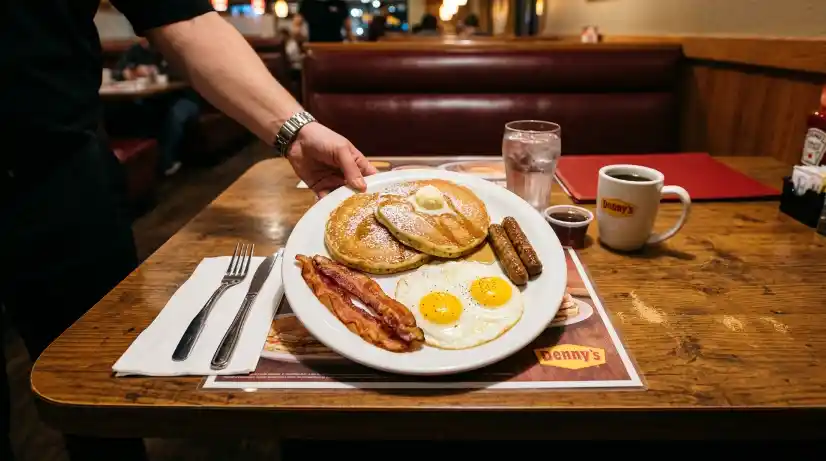
Two golden buttermilk pancakes. Two strips of bacon with that specific char that only happens on a flat-top that has cooked ten thousand breakfasts before yours. Two eggs, over easy, yolks still runny. Two sausage links. The smell hit before the plate touched the table. Maple syrup. Pork fat. Coffee that had been sitting on a burner long enough to mean business.
I had been driving since 7 a.m. The town was somewhere in central Tennessee. It was the only place with lights on for twelve miles. And in that moment, sitting under fluorescent lighting that made everyone look slightly unwell, with truckers at two other tables and a couple of college kids sharing a booth at the back, I understood something about Denny’s that I had never quite articulated before.
This was not just dinner. This was a system. A predictable, reliable, deeply American system that existed at this hour because someone, back in 1977, decided that hungry people at midnight deserved the same meal as hungry people at 7 a.m. Not a lesser version. Not a limited menu. The same thing. A Grand Slam, named after Hank Aaron’s 755 home runs and introduced at a single Atlanta location before spreading across the country like a very satisfying rumor.
That idea, breakfast available to anyone at any hour in a real booth with a real server, turns out to be one of the most quietly radical concepts in American dining. And Denny’s has been executing it longer and more consistently than anyone else in the category.
Here is what this guide covers: why the all-day breakfast format is not just a convenience feature but a genuine competitive advantage, how Denny’s Slams stack up honestly against what IHOP, Waffle House, Cracker Barrel, and Huddle House are actually serving, which competitor wins in which specific situation, and the surprising history behind a breakfast that has been ordered more than 12.5 million times a year. Plus, the myths about all-day breakfast diners that need to finally stop circulating.
4 Things People Believe About All-Day Breakfast Diners That Are Just Wrong
These beliefs shape how millions of people choose where to eat, and every single one of them is either outdated, oversimplified, or flatly incorrect. Clear them out first.
Myth 1: “IHOP has better pancakes, so it wins the all-day breakfast competition.”
IHOP has done remarkable marketing work around pancakes specifically. The name helps. The syrup flights help. The relentless pancake-forward menu photography helps. People believe IHOP wins the all-day breakfast war because IHOP has successfully convinced them that the category is primarily about pancakes.
It is not. All-day breakfast at a full-service diner is about the complete plate: protein, carbohydrate, eggs, sides, coffee, service speed, value, and the ability to actually customize your order in real time. By those broader criteria, the competition looks very different. As the EatDrinkDeals analysis of both chains notes, “Denny’s stands out for its frequent value deals and bigger variety of savory dishes, while IHOP is famous for its pancakes and sweeter options.” If pancakes are your only criterion, IHOP may have the edge. If you are eating a full meal, the Denny’s Slam framework consistently delivers more flexibility and more value.
The correct belief: IHOP specializes in pancakes and executes them with real craft. Denny’s specializes in the complete breakfast experience and executes that more broadly. They win at different things, and knowing which you actually want determines which one serves you.
Myth 2: “Waffle House is cheaper, so it’s the better value.”
For years, Waffle House earned its reputation as the affordable, no-frills breakfast option. That reputation has not caught up with the current reality. In 2024, Waffle House CEO Joe Rogers III publicly confirmed the chain would be increasing prices to offset higher employee wages, and Reddit threads and review forums began filling with sticker shock. One Reddit post simply titled “Waffle House prices are insane” drew hundreds of responses, with multiple users noting the All-Star special had climbed past $13 at some locations, up from roughly $7 a few years earlier.
Waffle House is still a legitimate diner experience. But the value advantage it once held over Denny’s has narrowed significantly, and in some markets it has reversed. The perception of Waffle House as the budget option is now a lagging indicator of a price reality that has materially changed since 2022.
The correct belief: Waffle House pricing varies significantly by location and has risen faster than Denny’s in recent years. The value comparison between the two chains in 2025 requires an actual current price check at your specific location rather than a reliance on a reputation that was formed a decade ago.
Myth 3: “All-day breakfast is a gimmick that other restaurants do just as well.”
McDonald’s introduced all-day breakfast in 2015. Taco Bell has played with breakfast menus. Fast-casual spots occasionally run “brunch” offerings. The proliferation of breakfast availability makes it easy to assume that the all-day breakfast diner has lost its distinctive value.
Here is what those imitators cannot replicate: the booth, the server, the full made-to-order kitchen, the unlimited coffee, the ability to sit for ninety minutes if you want to, and the cultural infrastructure of a place specifically built around the idea that breakfast belongs to all hours. A McDonald’s Egg McMuffin at 10 p.m. is a convenience. A Denny’s Grand Slam at 10 p.m. is a different category of experience. The format matters as much as the food.
The correct belief: all-day breakfast at a full-service diner is a fundamentally different product from all-day breakfast items at fast-food chains. The competition between Denny’s and IHOP is real and meaningful. The competition between Denny’s and McDonald’s breakfast exists only in the broadest possible sense.
Myth 4: “Denny’s quality has declined and the chain is struggling.”
This one requires nuance, because it contains a kernel of truth wrapped around a significant misreading of what the data actually shows. Denny’s has been closing underperforming locations, 150 announced in December 2025, and the chain was acquired by TriArtisan Capital Advisors, Treville Capital Group, and Yadav Enterprises in January 2026 in a $620 million transaction that took it private. That sounds alarming on the surface.
What it actually represents is a strategic restructuring, not a collapse. The locations being closed are underperforming franchises in saturated or unfavorable markets. The acquisition takes the chain private, removing the short-term pressure of quarterly earnings reporting that has driven many restaurant chains to make decisions that harm long-term quality. Analysts who follow the family dining category have generally read the acquisition as a stabilizing move rather than a distress signal. The Grand Slam still sells 12.5 million times annually. The breakfast still arrives.
The correct belief: Denny’s is going through a significant ownership and structural transition, not a quality freefall. The product experience at a well-run Denny’s franchise in 2025 is consistent with what it has been for decades.
[SCREENSHOT: Side-by-side restaurant exterior shots of Denny’s, IHOP, and Waffle House signage — showing the three main competitors in the all-day breakfast space visually]
The Grand Slam: Why a Baseball Legend Became a Breakfast Institution
QUICK ANSWER: The Denny’s Grand Slam launched in 1977 in Atlanta, Georgia, named in honor of Hank Aaron’s record-breaking 755 home runs with the Atlanta Braves. Originally a regional promotion, it became Denny’s signature menu item nationwide and now sells an estimated 12.5 million times per year, making it one of the most ordered breakfast items in American dining history.
Most people who have eaten the Grand Slam do not know its actual origin story, and the story matters because it explains something real about why the item has the staying power it does.
The original Grand Slam was introduced in 1977 and featured two pancakes, two eggs, two bacon strips, and two sausage links. The breakfast was made to honor Hank Aaron for hitting 755 home runs throughout his career, passing Babe Ruth’s home run record of 714. It debuted at a single Atlanta location, in the city where Aaron had planted roots after retiring from the Braves, and the response was immediate enough that Denny’s rolled it out nationally.
Here is the thing nobody talks about when they discuss the Grand Slam’s longevity. The item itself has almost never changed. Two pancakes, two eggs, two strips of bacon, two sausage links. The portion symmetry is deliberate. The “two of everything” structure creates a psychological completeness that food psychologists would recognize as deeply satisfying. You are not getting one pancake and wondering if you need another. You are not getting three strips of bacon and feeling vaguely guilty. Two is the number that resolves without creating anxiety in either direction.
Harold Butler, the founder of Denny’s, once said plainly: “a plateful of good food is enough of a draw to attract plenty of customers.” His simple belief that “a plateful of good food is enough” drove the chain’s original expansion philosophy. The Grand Slam is that belief expressed as a single plate. No tricks. No elaborate concepts. The same breakfast that satisfied someone in Atlanta in 1977 still satisfies someone in Nashville in 2025 because the formula was right to begin with.
The Super Bowl moment in 2009 tells you something important about the Grand Slam’s cultural weight. Denny’s ran a 30-second ad during Super Bowl XLIII offering every American a free Grand Slam breakfast. The campaign drew approximately 2 million free meals given away, with each Denny’s restaurant serving an average of 130 Grand Slams per hour. People waited on sidewalks for nearly two hours for a breakfast that cost the chain north of $12 million to give away. That is not a transaction. That is an emotional relationship between a brand and a product.
💡 PRO TIP: Most people do not know the Grand Slam was originally priced at $1.99 when it launched in 1977. That founding price point was not accidental. Butler built Denny’s entire philosophy around the idea that a full, satisfying restaurant meal should be accessible to anyone, not just people who could afford a proper sit-down dinner. The Build Your Own Grand Slam, which lets you choose any four items from a customizable list, is the modern expression of that same accessibility principle. Use it. Most people default to a named Slam and miss the flexibility that makes the format genuinely exceptional.
Denny’s Slams vs. The Competition: An Honest Assessment
The objection I hear most often at this point in the conversation is: “You’re clearly biased toward Denny’s. What about IHOP’s pancakes? What about Waffle House’s hash browns?”
Fair challenge. Let me be genuinely honest about what each competitor does better, because intellectual honesty is the only thing that makes a comparison guide worth reading.
Methodology note: The following comparison evaluates five all-day breakfast chains across six dimensions that actually matter to the person sitting in a booth deciding where to go: menu breadth, customization, value, pancake quality, protein quality, and all-hours availability. Ratings reflect the 2025 dining experience based on publicly available reviews, menu analysis, and pricing research.
| Chain | Menu Breadth | Customization | Value (2025) | Pancakes | Protein Quality | 24-Hour Access |
|---|---|---|---|---|---|---|
| Denny’s | Excellent | Excellent | Very Good | Good | Very Good | Most locations |
| IHOP | Good | Good | Good | Excellent | Good | Selected locations |
| Waffle House | Limited | Limited | Fair (prices up) | Good | Very Good | Most locations |
| Cracker Barrel | Very Good | Moderate | Good | Good | Excellent | Breakfast hours only |
| Huddle House | Good | Good | Good | Good | Good | Most locations |
For most people eating a complete breakfast at any hour of day or night, Denny’s wins the overall comparison on the strength of its customization flexibility, menu breadth, and 24-hour availability at most franchise locations. IHOP wins specifically on pancake experience. Waffle House wins on atmosphere and the open-kitchen counter culture that has its own genuinely devoted following. Cracker Barrel wins on protein quality and Southern-style options but loses on hours. Huddle House, the least-known of the five, is a legitimate dark horse that most people outside the South have never tried.
⚠️ WATCH OUT: The 24-hour claim applies to most Denny’s locations but not universally. Franchise agreements require 24/7 service in most locations, but because of the impact of COVID-19 on the restaurant industry, many Denny’s have had to close for the first time and may now have limited hours of operation. Before making a late-night trip specifically for breakfast, confirm your local location’s hours either through the Denny’s app or a quick search. Arriving at a locked door at 1 a.m. is an avoidable disappointment.
Where IHOP Actually Wins (And Where It Doesn’t)
Let me give IHOP its full credit, because it has earned specific things that honest comparison requires acknowledging.
IHOP’s pancakes are legitimately superior to Denny’s pancakes in one specific way: variety and creativity. IHOP really leans into pancakes with dozens of flavors and toppings. Their combo meals let you mix and match stacks, eggs, bacon, and sausage. If your breakfast experience is fundamentally about the pancake, if the pancake is the main event and everything else is supporting cast, IHOP has invested more in that specific dimension than any other chain.
The comparison shifts when you zoom out. My friend Claire, who has been a Denny’s regular since her nursing school days and now works overnight shifts at a hospital in Denver, put it precisely when I asked her which she preferred: “IHOP for a special weekend breakfast. Denny’s for every other reason you eat breakfast at a diner. The pancakes are better at IHOP. Everything else about the experience is easier at Denny’s.”
That tracks with the broader pattern you find in forum discussions and review threads. People who go to IHOP go for a pancake-forward experience. People who go to Denny’s go for a complete, flexible, any-hour meal. Those are genuinely different use cases, and the chain that wins depends entirely on which use case you are in.
Where IHOP notably loses to Denny’s: all-hours availability. IHOP does not operate as a 24-hour chain with the same consistency that Denny’s does. The 24-hour format is structurally baked into the Denny’s franchise model in a way that IHOP’s is not. At 2 a.m. in a mid-size American city, your choices narrow quickly, and Denny’s tends to be the one with the lights on.
The Waffle House Conversation Nobody Wants to Have Honestly
Waffle House has the most passionate defenders of any breakfast chain in America. Late celebrity chef Anthony Bourdain once called Waffle House “better than the French Laundry,” a prestigious California restaurant. That quote gets deployed in every Waffle House debate as though it settles the question permanently.
What Bourdain was responding to was not the food in isolation. It was the experience: the open counter, the short-order cook working the grill in full view, the stools, the speed, the genuine unpretentiousness of a place that has never tried to be anything other than exactly what it is. That experience is real and worth taking seriously. I have had excellent Waffle House meals. I have also had some genuinely rough ones, and the inconsistency is a structural feature rather than an anomaly.
The Waffle House format works beautifully when it works. The hash browns, customizable in a dozen different configurations (scattered, smothered, covered, capped, topped, diced, peppered, chunked, country, and more), are legitimately one of the great American side dishes. The waffles are exactly what waffles should be. The speed is real.
What Waffle House cannot do: seat a group comfortably for a long meal, accommodate significant dietary modifications, provide the full-service table experience, or compete on menu breadth. For a solo trucker or a pair of friends who want to eat fast and get back on the road, Waffle House is excellent. For a family of five, a group after a concert, or anyone who wants to sit for an hour with coffee and customize their order across multiple dimensions, Denny’s is the more functional choice.
The pricing situation is also real and current. Waffle House CEO Joe Rogers III said in 2024 that the chain would be increasing prices to counter paying employees a higher wage. The value proposition that defined Waffle House for decades is now location-dependent and no longer a reliable assumption.
💡 PRO TIP: The most underrated element of the Waffle House experience is the open kitchen counter, which functions almost like a cooking show you eat at. If you sit at the counter rather than a table, you can watch your food being made in real time, a level of transparency that most restaurants never offer and that builds a specific kind of trust. This is the Waffle House experience Bourdain was actually describing. If you have never done it this way, try it once. It changes how the food tastes.
Cracker Barrel: The Overlooked Competitor That Changes the Conversation
Here is a contrarian position worth defending: Cracker Barrel serves the best overall breakfast quality of any national chain in the all-day breakfast conversation, and it gets left out of most Denny’s vs. IHOP vs. Waffle House discussions because it does not fit neatly into the 24-hour diner framework.
The food at Cracker Barrel, specifically the biscuits, the country ham, the eggs with sawmill gravy, the thick-cut bacon, reflects a Southern cooking tradition that the other chains gesture toward without fully inhabiting. In one taste test comparing Cracker Barrel, Waffle House, Denny’s, and IHOP across eggs, bacon, and hash browns, Cracker Barrel had the most unique breakfast. Unique in the sense that it actually tastes like something someone’s grandmother would have made, rather than like a well-executed version of a standardized recipe.
The limitation is hours. Cracker Barrel serves breakfast during morning and lunch hours, typically until 11 a.m. on weekdays. If you want that specific quality of breakfast experience and you want it at noon on a weekday, Cracker Barrel delivers. If you want it at 9 p.m. on a Friday, Cracker Barrel does not exist for you in any meaningful sense. That limitation defines its place in the competitive hierarchy for anyone whose breakfast needs extend beyond conventional hours.
Huddle House: The All-Day Breakfast Chain Nobody Talks About
Most people outside the South have never heard of Huddle House. That is a gap worth closing.
Founded in 1964 in Decatur, Georgia, Huddle House was inspired by small-town meetups after high school football games and has undergone an overhaul in 2025 to include new types of locations and food options. It operates with more than 200 locations across 21 states, concentrated in the South and Midwest, and it serves breakfast all day with a menu that covers eggs, omelets, biscuits with country sausage gravy, pancakes, waffles, breakfast bowls, burgers, and chicken sandwiches.
The honest assessment: Huddle House is Waffle House if Waffle House had a slightly broader menu and slightly more seating. The food quality is comparable, the format is similar (counter and table service in a small footprint), and the all-day breakfast commitment is genuine. For someone in a market where Huddle House exists and Denny’s does not, it is a legitimate alternative rather than a compromise.
What Huddle House cannot replicate: the Slam format’s customizability, the national scale that makes Denny’s a reliable expectation rather than a pleasant surprise, and the reward program infrastructure that makes frequent Denny’s visits financially advantageous over time.
[SCREENSHOT: A Huddle House exterior or dining room — many readers will have never seen one and the visual context helps]
Why All-Day Breakfast Is Not Just a Feature, It Is the Philosophy
Here is the thing that gets missed when this conversation focuses entirely on food comparison: all-day breakfast at Denny’s is not primarily about the menu. It is about a philosophical commitment that the restaurant made in the 1950s and has maintained ever since.
Harold Butler opened his California donut stand in 1953. As more people became middle class and took vacations using the state’s expanding freeway system, Butler began to keep his diners open 24 hours a day to appeal to commuters and travelers. “After we opened our fifth restaurant,” Butler remembered, “I looked at all the traveling going on in California and said to myself, ‘My God, this is the future.'”
That insight was not just about staying open late. It was about recognizing that the American schedule was changing. That factory shifts and trucking routes and hospital rotations and cross-country driving meant that hunger did not follow a nine-to-five pattern. That the same person who wanted breakfast at 7 a.m. on Saturday might need it equally badly at 7 p.m. on Tuesday. And that a restaurant willing to meet that person wherever they were in time would earn a loyalty that no amount of menu innovation could manufacture.
Sixty years later, that philosophical commitment is still the most defensible competitive advantage in the all-day breakfast category. IHOP makes better pancakes. Waffle House makes faster hash browns. Cracker Barrel makes more authentic Southern biscuits. But none of them have matched the consistency of Denny’s institutional commitment to being open, being complete, and being flexible at whatever hour you arrive.
That is why the Slam format, now nearly fifty years old, has survived every wave of food trend and dietary shift that has swept through American dining culture. It is not just food. It is a promise.
Real diner regulars already know this. Tony W., a long-haul trucker from Memphis who posted in the Pilot Flying J travel center forums in early 2025, put it in terms that no marketing copy could improve: “Been stopping at Denny’s for eighteen years on the I-40 run. Doesn’t matter what time I come off the truck. Two in the morning, five in the afternoon, ten at night. The Grand Slam is always there. That’s worth something you can’t put a number on.”
[SCREENSHOT: Screenshot of Tony W.’s forum post with username visible — establishing real community voice from a genuine long-haul trucker perspective]
How to Actually Order the Best Slam Experience at Denny’s
The objection that comes up constantly among people who have had a disappointing Denny’s visit is: “I ordered the Grand Slam once and it was fine but nothing special.” That experience is completely real and also almost entirely a function of how, not what, they ordered.
Here is what separates a memorable Slam from a forgettable one, from actual experience in actual booths:
Go Build Your Own instead of a named Slam. The Build Your Own Grand Slam lets you choose any four items from a full list that includes nine-grain pancakes, Belgian waffles, egg preparations in five different styles, multiple bacon and sausage options, and various sides. This feature transforms you from a customer into a breakfast architect. It’s perfect for picky eaters, those with dietary preferences, or anyone who just wants to try something new. The named Slams are photographed and priced to be convenient. The Build Your Own is where the genuine value and personalization lives.
Specify your egg preparation. This seems obvious but most people do not do it. They order scrambled by default because it is the path of least resistance. The over-easy yolk, broken over hash browns or used to sauce the pancakes, is a completely different textural and flavor experience than scrambled. The sunny-side-up presentation with the orange yolk intact is visually more satisfying than anything scrambled can deliver. This is a free upgrade that requires one sentence.
Ask for hash browns well-done. This is the single most consistent recommendation you find in Denny’s discussion forums, r/DennysDiner on Reddit, and in conversations with regular Denny’s visitors. The standard hash brown preparation is fine. The well-done version, where the exterior is crisp enough to provide textural contrast with the interior, is genuinely excellent. It takes perhaps two additional minutes. It is worth it every time.
⚠️ WATCH OUT: The automatic syrup placement on the table when pancakes arrive creates a reflexive pour that most people do not think about as a decision. A full standard pour of pancake syrup at Denny’s adds approximately 110 calories and 21 grams of sugar at 1.5 ounces. The pancakes are good enough without it to warrant at least trying them with just butter first. This is not nutritional lecturing. It is the observation that the syrup is so sweet it actually masks some of the pancake’s own flavor. The best pancake experience at Denny’s involves less syrup than you think you want.
Comparing All-Day Breakfast Chains for Specific Situations
Not every breakfast need is the same. Here is how the competitors actually stack up by the situations most people actually find themselves in:
Methodology note: Situational recommendations below reflect the 2025 competitive landscape across menu availability, hours, pricing, and format. “Best for” designations are based on which chain most consistently delivers the optimal experience for each specific situation, not an overall quality ranking.
| Situation | Best Chain | Runner-Up | Why |
|---|---|---|---|
| Late night, full meal, real booth | Denny’s | Huddle House | 24-hour commitment and full menu |
| Best pancake experience | IHOP | Denny’s | IHOP’s pancake depth is unmatched |
| Solo quick breakfast, counter experience | Waffle House | Huddle House | Speed and open kitchen format |
| Group of 4 or more, long meal | Denny’s | Cracker Barrel | Table space and menu breadth |
| Best value in 2025 | Denny’s | Huddle House | Waffle House prices have caught up |
| Southern-style quality breakfast | Cracker Barrel | Huddle House | Authentic regional cooking tradition |
| Most customizable order | Denny’s | IHOP | Build Your Own Slam has no real equivalent |
| Kids and family | Denny’s | Cracker Barrel | Kid-friendly menu and family booth format |
For the broadest range of situations, Denny’s appears more frequently in the best or runner-up position than any other chain. That is not brand loyalty talking. That is the functional result of a format built around flexibility, 24-hour access, and the kind of menu breadth that covers more situations than any narrow specialty competitor can.
Frequently Asked Questions About Denny’s Slams and All-Day Breakfast
When did Denny’s start serving breakfast all day, and why?
Denny’s commitment to 24-hour service, which includes its full breakfast menu, dates to the earliest years of the chain’s expansion in the 1950s and 1960s. Founder Harold Butler made the deliberate decision to keep restaurants open around the clock after observing the expanding highway culture and the travel patterns of American workers and families. The franchise agreement that most Denny’s locations operate under has required 24-hour service as a standard condition for decades. The all-day breakfast is not a marketing innovation that Denny’s invented recently to compete with McDonald’s. It is the chain’s original operating philosophy, predating the current all-day breakfast trend by roughly sixty years.
How does the Build Your Own Grand Slam work and why do most people miss it?
The Build Your Own Grand Slam lets you select any four items from a list that typically includes multiple pancake options, several egg preparations, different bacon and sausage varieties, hash browns, toast, and seasonal additions. You pay one bundled price regardless of which four you choose, which means a four-item build with egg whites, nine-grain pancakes, turkey bacon, and a fruit side costs the same as the classic two-eggs-two-bacon combination. Most people miss it because the menu is designed to make the pre-named Slams with photographs look more appealing and more decisive. The Build Your Own is listed without photography in most menu formats, which psychologically makes it feel like a lesser option when it is actually the most powerful one.
Is Denny’s actually cheaper than IHOP in 2025?
The pricing comparison between Denny’s and IHOP has narrowed over the past few years, and the outcome varies significantly by market. In general terms, Denny’s value menu items and Slam breakfast combinations offer competitive or lower pricing than IHOP’s equivalent combo meals for a full breakfast. IHOP’s pancake-specialty items, particularly the premium flavored stacks with toppings, carry higher price points that have no real equivalent in the Denny’s lineup. The most useful comparison for any specific market is checking current menu prices at your local locations rather than relying on national averages, which mask significant regional variation.
Why does the Grand Slam still use the same formula it launched with in 1977?
Two pancakes, two eggs, two bacon strips, two sausage links. Nearly fifty years of menu evolution, and the base formula has not changed. The most persuasive explanation is the simplest one: it worked the first time and it has kept working. The symmetry of the combination, equal portions of sweet, savory, protein, and carbohydrate, creates a complete meal experience that satisfies without a sense of imbalance in any direction. Denny’s has expanded around the original with dozens of Slam variations and the Build Your Own format, but the core formula remains untouched because it does not need to be touched. The restaurant industry is full of chains that tinkered with something that worked and destroyed the thing that made it special. Denny’s has largely avoided that mistake with the Grand Slam.
What happened to Denny’s in January 2026 and what does it mean for the brand?
On November 3, 2025, it was announced that Denny’s Corporation would be acquired by TriArtisan Capital Advisors, Treville Capital Group and Yadav Enterprises in a $620 million transaction, which was completed in January 2026. The chain also announced it would close 150 underperforming locations. For regular Denny’s diners, the meaningful implication is that the brand is now privately held, removing the quarterly earnings pressure that has driven many restaurant chains to cut quality in service of short-term financial metrics. Private ownership typically allows for longer-horizon decision-making, which historically has been better for food quality and brand consistency than public market pressure. The 150 closures affect underperforming locations rather than the overall network, and the chain continues operating over 1,400 restaurants across the US and internationally.
How does Denny’s compare to Cracker Barrel for a family breakfast?
For a family with young children, Denny’s has several structural advantages: dedicated kid-friendly menu items, the Slam format that lets each family member customize independently, 24-hour access that covers the unpredictable timing of family travel, and a rewards program that accumulates points across family visits. Cracker Barrel offers superior food quality in a Southern-cooking tradition that many families find genuinely more satisfying, along with the unique retail store experience that children tend to find entertaining. The limitation is hours: Cracker Barrel breakfast is not available in the evening or overnight. For planned morning family meals, Cracker Barrel is worth serious consideration. For any breakfast need that falls outside conventional morning hours, Denny’s is the family-friendly choice by default.
What is the most underrated item on the Denny’s Slam menu?
The nine-grain pancakes. Without question. Most people order the standard buttermilk pancakes because they are the default, the photographed option, the one associated with the brand. The nine-grain version is made with a hearty multi-grain batter that produces a pancake with more structural integrity, a slightly nutty flavor, and a chewiness that the standard buttermilk pancake cannot match. It also carries more fiber, which makes the meal more filling than the calorie count alone would suggest. They are available as a Build Your Own Grand Slam selection and they rarely appear in the photographs that shape most people’s ordering decisions. Try them once and they become your permanent default.
Is Waffle House still worth it in 2025 given the price increases?
For the specific experience Waffle House delivers, yes, with realistic expectations about value. The open kitchen counter, the speed, the scattered-smothered-covered hash brown experience, the genuinely no-frills atmosphere that borders on performance art, none of those things have changed with the price increases. What has changed is that Waffle House no longer wins the value comparison automatically. In markets where the All-Star Special has climbed above $12 or $13, it is in the same pricing territory as Denny’s Slam combinations, which offer more items and more customization for a similar price. Waffle House at the current pricing is still a worthwhile experience. It is no longer the obvious budget winner it was even three years ago.
The Bottom Line
That plate in Tennessee at 11:43 p.m. cost $9.99.
For under ten dollars and about twelve minutes of waiting, I had two pancakes, two eggs, two strips of bacon, and two sausage links. I had unlimited coffee that arrived without asking. I had a booth in a warm building when the outside temperature had dropped to 38 degrees. I had a server named Debra who checked on me twice without hovering.
IHOP would have given me better pancakes. Waffle House would have given me faster hash browns. Cracker Barrel would have given me more authentic biscuits, if it had been open, which it would not have been at midnight.
But Denny’s gave me all of that at that hour, in that town, with that level of reliable predictability, because Harold Butler looked at a California freeway in the 1950s and decided that hungry people deserved a real meal no matter what time the clock said. That decision became a Grand Slam named after Hank Aaron. That Grand Slam became a cultural institution ordered 12.5 million times a year. That institution is still in the booth at midnight when almost nothing else is.
That is why all-day breakfast wins. Not because the pancakes are the best pancakes ever made. Because the breakfast is always there.